

AI Literacy for Software Engineers in 2026
- Feb 24
- 3 min read
Every Software Engineer Must have in 2026

Software engineering is undergoing its most significant transformation since the internet. Artificial intelligence is no longer an optional specialty — it is woven into the fabric of how we build, ship, and maintain software. Whether you write backend APIs, build frontends, lead a platform team, or manage ML infrastructure, the ability to reason about, implement, and critique AI systems is now a core engineering competency.
This guide defines the essential AI literacy every software engineer needs in 2026. We'll cover foundational concepts, practical integration skills, safety & evaluation, and a roadmap to get you there.
The AI Literacy Pyramid
AI literacy is not binary. It scales with your role, responsibilities, and ambitions. The pyramid below shows four levels that every engineer should understand, and actively work toward climbing.

AI literacy is not binary. It scales with your role, responsibilities, and ambitions. The pyramid below shows four levels that every engineer should understand, and actively work toward climbing.
Core Knowledge Areas
Below are the six knowledge domains every software engineer must develop in 2026. Each builds on the last.

Prompt Engineering Deep Dive
Prompt engineering is the most immediately useful skill an engineer can develop. Think of it as programming in natural language — with all the same principles of clarity, structure, and iteration.
Five Pillars of Effective Prompting
1. Persona & Role — Set a clear persona in the system prompt to constrain model behavior
2. Context & Background — Give the model exactly what it needs, nothing extraneous
3. Task Specification — Be explicit about the output format, length, and constraints
4. Examples (Few-Shot) — Show don't tell: provide 1-3 input/output examples
5. Chain-of-Thought — For complex reasoning, ask the model to think step by step before answering
Common Prompt Patterns
Pattern | Use Case | Example Prompt |
|---|---|---|
Zero- Shot | Simple tasks the model knows well | "Summarize this text..." |
Few- Shot | Structured output or specific tone | "Here are 3 examples, now..." |
Chain-of- Thought | Math, logic, multi-step reasoning | "Think step by step..." |
React | Agentic tool use and planning | "Reason and act: observe..." |
Self-Consistency | High-stakes answers | "Generate 5 responses, then synthesize..." |
Meta-Prompting | Generate prompts from prompts | "Write a prompt that will..." |
RAG Architecture Explained
Retrieval-Augmented Generation (RAG) is the most widely deployed pattern for grounding LLMs in real-world, up-to-date data. Every engineer building knowledge-intensive features must understand it.


AI in the Software Development Lifecycle
AI is transforming every phase of the SDLC. Engineers who understand where and how to apply it gain compounding productivity advantages. Here's where AI fits:
SDLC Phase | AI Application | Tools/ Patterns |
|---|---|---|
Planning | Requirement analysis, story generation | GPT, Claude, Notion AI |
Design | Architecture diagramming, API spec | Copilot, Cursor, GitHub Models |
Implementation | Code generation, autocomplete, refactoring | Cursor, GitHub Copilot, Codeium |
Testing | Test case generation, mutation testing | CodeiumAI, Diffblue, Testim |
Code Review | Automated PR summaries, bug detection | CodeRabbit, Sourcery, Qodana |
Deployment | Config generation, runbook drafting | PulumiAI, Terraform, Copilot |
Monitoring | Anomaly detection, log summarization | New Relic AI, Datadog Bits AI |
Documentation | Auto-docs, changelog generation | Mintify, Swimm, GitHub Copilot |
AI Safety & Evaluation
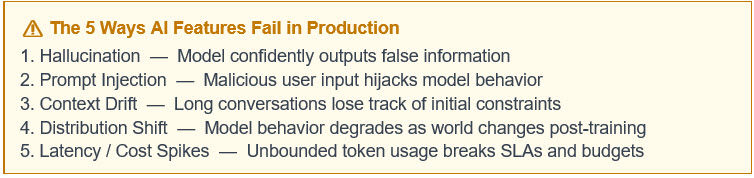
Production AI systems fail in ways traditional software does not. Hallucinations, prompt injections, drift, and emergent behaviors require new engineering disciplines. This is perhaps the most underinvested area.
Building an Eval Harness
Eval Type | What it Measures | Implementation |
|---|---|---|
Functional | Does it return the right answer? | Unit tests with golden datasets |
Semantic | is the meaning equivalent | Embedding similarity scores |
LLM as a judge | is the quality acceptable | GPT or Claude rates output from 1-5 |
Human Eval | Do human prefer this | A/B testing, preference data |
Red-Team | Can it be jailbroken? | Adversarial prompt suites |
Your AI Literacy Roadmap
Feeling overwhelmed? Don't be. A targeted training will take you from AI consumer to AI integrator — the sweet spot for most engineers.

AI literacy is not about becoming a data scientist or machine learning researcher. It's about developing the judgment to know when AI helps, when it hurts, how to integrate it responsibly, and how to debug it when it fails. These are engineering skills — and they are learnable.
The engineers who ignore AI will spend their careers cleaning up after it. The engineers who master it will design the systems that define the next decade. The choice is entirely yours.


Comments